Beyond Simple Prompts: How Multi-Agent Systems Are Redefining Data Engineering Pipelines
For the past couple of years, Generative AI in the data engineering space was mostly treated as a glorified autocomplete tool. We used Large Language Models (LLMs) to draft SQL queries, write standalone Python scripts, or explain cryptic stack traces.
While helpful, these single-prompt interactions suffered from a fundamental bottleneck: context decay and lack of autonomy.
If a generated pipeline failed midway, a human engineer had to intervene, copy-paste the error log back into the chat window, and manually guide the LLM toward a fix.
That reactive era is ending. We are moving from passive text completion to active, autonomous orchestration through Multi-Agent AI Systems.
By combining specialized, collaborative AI agents—built on frameworks like CrewAI, AutoGen, and LangGraph—data teams are building self-healing, fully autonomous data pipelines that plan, execute, validate, and debug workflows with minimal human oversight.
2. The Shift: Single-Prompt LLMs vs. Multi-Agent Architectures
Why does a single LLM struggle with complex data engineering tasks? Because building a reliable data pipeline requires multiple distinct roles and skill sets that often conflict.
A single prompt asking an LLM to “build, test, and optimize an ETL pipeline” usually yields generic, brittle code.
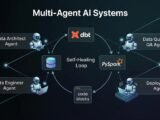
Multi-Agent systems solve this by breaking down complex engineering workflows into a network of role-specific, autonomous agents that communicate through structured feedback loops:
[ Data Architect Agent ] ──> Generates Schema & Pipeline Architecture
          │
          ▼
[ Data Engineer Agent ]  ──> Writes ETL Code & Transformation Logic
          │
          ▼
[ Data Quality Agent ]   ──> Executes Unit Tests & Schema Validations
          │
   (Tests Fail?) ──> Returns Error Logs to Engineer Agent to Self-Heal
          │
   (Tests Pass!)
          ▼
[ Deployment Agent ]     ──> Commits to Git & Deploys Orchestration DAG
3. How Multi-Agent Workflows Function in Practice
Instead of executing a monolithic script, each agent in the ecosystem is equipped with specific system prompts, memory stores, and operational tools (such as database connectors, Python execution environments, or dbt CLI access).
Here is how a multi-agent swarm handles an automated data onboarding task:
1. The Schema Discovery Agent
Ingests raw, unstructured payload samples from a new third-party API. It detects data types, maps nested JSON structures, and flags potential privacy violations (such as unmasked PII).
2. The Transformation Agent
Takes the approved schema design and automatically generates modular dbt models or PySpark transformation code, ensuring best practices like idempotency and partitioning are applied.
3. The Quality Assurance & Testing Agent
Generates and runs data quality assertions (e.g., checking for null values, schema drift, or distribution anomalies). If a test fails, the QA agent captures the execution traceback and routes it back to the Transformation Agent with instructions on how to refactor the code.
4. The Self-Healing Loop
If the pipeline breaks during production due to an unexpected API schema change, the agents intervene automatically. The monitoring agent intercepts the failure, isolates the broken model, generates a patch, tests it in a staging environment, and alerts the human engineer with a ready-to-merge Pull Request.
4. The New Role of the Human Data Engineer
Does the rise of autonomous agent swarms mean data engineers are obsolete? Not at all.
Instead of spending 70% of their time writing repetitive boilerplate ingestion code, debugging broken Regex patterns, or manually mapping database schemas, human engineers are elevating their role to Agent System Architects and Policy Controllers.
The focus shifts toward:
- Setting Boundary Guardrails: Defining strict operational limits, security policies, and cost thresholds for agent execution.
- Architectural Design: Structuring the high-level data models and decision hierarchies that agents must follow.
- Human-in-the-Loop Approval: Serving as the final authorization checkpoint for high-risk production deployments.
5. The Future: From Static Scripts to Living Ecosystems
Data pipelines are transitioning from static, hard-coded scripts to dynamic, agentic workflows. As multi-agent orchestration frameworks mature, the data platforms of tomorrow will not just execute instructions—they will continuously reason, adapt, and optimize themselves in real time.
For data leaders and engineers, mastering agentic frameworks is no longer an experimental hobby; it is the core skill required to build scalable, resilient data infrastructure in the age of autonomous AI.
References (International Standard)
- WU, Q., et al. AutoGen: Enabling Next-Gen LLM Applications via Multi-Agent Conversation Framework. arXiv preprint arXiv:2308.08155, 2024.
- CREWAI. Multi-Agent Orchestration for Enterprise Data Pipelines. CrewAI Technical Architecture Documentation, 2025.
- LANGCHAIN. LangGraph: Building Stateful, Multi-Actor Applications with LLMs. LangChain Research Series, 2025.