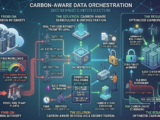
Carbon-Aware Data Engineering: Scheduling High-Compute Workloads Based on Grid Intensity
As Artificial Intelligence models scale exponentially and data lakehouses expand into petabyte territory, the IT sector’s energy footprint has shifted from a peripheral concern to a primary architectural challenge. Training large neural networks and running continuous, high-throughput ETL/ELT pipelines require immense computational power.
Historically, data engineering optimization focused almost exclusively on two metrics: execution speed (latency) and infrastructure cost.
However, a third critical dimension has emerged in modern cloud architecture: carbon intensity.
Welcome to Carbon-Aware Data Engineering—the practice of dynamically designing, scheduling, and orchestrating computational workloads based on the real-time carbon intensity of the underlying power grid.
2. What is Grid Carbon Intensity?
The electricity powering cloud data centers comes from a dynamic mix of energy sources: renewables (wind, solar, hydro) and fossil fuels (gas, coal).
Because weather conditions and demand fluctuate throughout the day, the carbon intensity—measured in grams of $CO_2$ emitted per kilowatt-hour ($gCO_2/kWh$)—changes constantly across different regional power grids.
Low Carbon Intensity (e.g., 20 gCO2/kWh)  <── Solar peak / High wind
High Carbon Intensity (e.g., 400 gCO2/kWh) <── Peaker plants active / Low renewables
Standard cloud schedulers dispatch batch jobs whenever data arrives or on rigid cron schedules (e.g., every midnight), completely blind to grid conditions. Carbon-aware engineering breaks this pattern by integrating real-time grid telemetry into the orchestration engine.
3. Architectural Strategies: Time-Shifting vs. Spatial-Shifting
To make compute workloads carbon-aware, data architects employ two primary strategies:
A. Temporal Shifting (Time-Shifting)
Many heavy data engineering tasks—such as daily vector index re-indexing, historical data backfills, weekly model retraining, or bulk database vacuums—are not time-critical.
Instead of triggering a 4-hour Spark job at 00:00 UTC when peaker plants might be running, a carbon-aware orchestrator (like Apache Airflow or Prefect integrated with APIs such as Electricity Maps or WattTime) delays execution until the local grid reaches its peak clean energy generation (e.g., midday solar peak).
B. Spatial Shifting (Location-Shifting)
For workloads that cannot wait, cloud-native pipelines can shift the location of the compute nodes. If a data center in Region A (e.g., US-East) is currently experiencing high carbon intensity due to low wind generation, the orchestrator dynamically spins up ephemeral Kubernetes clusters or serverless workers in Region B (e.g., Europe-North or South America), where hydro or nuclear power is dominating the local grid.
4. Implementing Carbon-Aware Orchestration in Practice
Building a carbon-aware pipeline doesn’t require reinventing your data stack. It involves adding a dynamic condition layer to your DAGs (Directed Acyclic Graphs):
- Telemetry Ingestion: Query grid intensity APIs to fetch real-time and forecasted $gCO_2/kWh$ metrics for your cloud provider’s target regions.
- Threshold Evaluation: Set threshold rules within your orchestrator. If current carbon intensity is above a defined limit (e.g., $> 150 gCO_2/kWh$), defer non-urgent tasks.
- Compute Auto-Scaling: Leverage serverless or spot instance fleets that scale down to zero when clean energy availability dips below optimal parameters.
By combining temporal and spatial shifting, organizations can achieve up to a 30% to 50% reduction in carbon emissions for batch computing tasks without changing a single line of business logic or incurring higher cloud costs.
5. The Future: Carbon-Efficiency as a Core Metric
The era of unconstrained, energy-agnostic compute is coming to an end. Sustainable IT is no longer just a corporate ESG marketing talking point; it is becoming an operational standard driven by regulatory frameworks and cloud cost-efficiency.
By integrating carbon-awareness into data pipeline design, data engineers demonstrate that software efficiency and environmental responsibility go hand in hand. Optimizing for the grid isn’t just good for the planet—it is the signature of a truly mature, modern data architecture.
References (International Standard)
- GREEN SOFTWARE FOUNDATION. Software Carbon Intensity (SCI) Specification v1.0. GSF Technical Report, 2023.
- RADAVANIC, A., et al. Carbon-Aware Computing for Datacenters: Challenges and Opportunities. IEEE Transactions on Sustainable Computing, v. 9, n. 1, p. 34-48, 2024.
- WATT TIME. Real-Time Carbon-Aware Software Architecture Guidelines. Environmental Defense Fund / WattTime Technical Whitepaper, 2025.
💼
#DataEngineering #GreenIT #Sustainability #CloudArchitecture #ApacheAirflow #BigData #CleanEnergy #BigheadGuru