TV 3.0 and the Edge Streaming Revolution: How Bilateral Data Streams Redefine Predictive Analytics
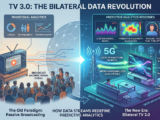
For decades, television has been a one-way street. Broadcasters pushed content down a massive pipeline, and millions of households passively consumed it. Advertisers and media companies estimated audience engagement using primitive, sample-based metrics like regional ratings.
In the data science world, TV was essentially a “black box” of unidirectional output.
But the television landscape is undergoing its most radical transformation since the transition from black-and-white to color. We are entering the era of TV 3.0—a new broadcasting standard that merges traditional over-the-air signals with broadband internet (powered by 5G and 6G networks).
The defining feature of this evolution? Bilateral data streams.
Suddenly, the screen in the living room is no longer just a receiver; it is an active edge node capable of transmitting high-velocity micro-interactions back to the ecosystem. For data scientists, this shifts the entire paradigm of predictive analytics and behavioral modeling.
2. From Broadcast to Bilateral: The Infrastructure of TV 3.0
To understand the analytical challenge, we have to look at the underlying architecture. TV 3.0 is built on a hybrid delivery model. While the heavy video payload (the 4K or 8K stream) can still travel over traditional broadcast frequencies, the interactive features, personalized ads, and application layers run over IP networks.
This creates a continuous, two-way feedback loop between the viewer’s device and the content platform.
Every remote control click, every instant purchase made during a live match, every language setting toggle, and even localized viewing patterns are captured as real-time events.
Instead of waiting days or weeks for consolidated viewing statistics, data pipelines now ingest millions of concurrent interaction packets per second at the edge.
3. Real-Time Analytics at the Edge
Processing the sheer volume of bilateral data generated by millions of connected TVs is a nightmare for centralized cloud architectures. If you try to route every single interaction packet to a central data warehouse for processing, the latency destroys the user experience.
This is where Edge AI and federated analytics come into play.
In a TV 3.0 framework, predictive models must run close to the consumer. Data scientists are designing lightweight, edge-compatible models that operate directly on smart TVs or localized edge gateways (like 5G cell towers).
- Micro-Personalization: Instead of relying on broad demographic profiles, localized algorithms process real-time clickstream data to dynamically insert targeted, programmatic ad blocks during live broadcasts.
- Predictive Bandwidth Allocation: By analyzing localized consumption spikes and device telemetry in real-time, networks can predict traffic congestion and dynamically adjust stream quality or routing before buffering ever occurs.
4. The Data Science Challenge: Harnessing High-Velocity Streams
For data professionals, working with TV 3.0 bilateral data requires a shift in technical focus. The traditional batch-processing mindset (ETL) is completely obsolete in this space. Data scientists must master:
- Event-Driven Architectures: Building robust real-time streaming pipelines using technologies like Apache Kafka or Apache Flink to ingest, clean, and process continuous telemetry.
- Privacy-Preserving Machine Learning: Because bilateral TV streams collect highly personal behavioral data, compliance frameworks like GDPR and LGPD are critical. Data teams must implement techniques like Federated Learning (training models locally on devices without centralizing raw user data) to protect consumer privacy.
- Anomalous Pattern Detection: Distinguishing genuine user engagement from automated traffic or device errors across millions of concurrent connections.
5. The Future: A Highly Interactive Ecosystem
The TV 3.0 revolution changes the relationship between content, commerce, and data. As we transition from passive watching to active, bilateral engagement, the TV screen becomes the ultimate portal for real-time transactional data.
For data scientists, the challenge is no longer just predicting what someone will watch next based on historical logs. The new frontier is predicting how they will interact with live, real-time ecosystems as they happen—turning broadcast television into the world’s most sophisticated, interactive data network.
References (International Standard)
- ADVANCED TELEVISION SYSTEMS COMMITTEE (ATSC). ATSC 3.0 Standard: System Discovery and Signaling. Washington, D.C.: ATSC, 2024.
- FELDMAN, R.; SILVA, A. Edge Computing and the Future of Interactive Broadcasting: A Data Science Perspective. Journal of Real-Time Image Processing, v. 18, n. 4, p. 345-359, 2025.
- INTERNATIONAL TELECOMMUNICATION UNION (ITU). Requirements for Next-Generation Interactive Television Services (TV 3.0). Geneva: ITU-T Recommendation Series, 2025.
#DataScience #TV3 #EdgeAI #PredictiveAnalytics #BigData #5G #MachineLearning #BigheadGuru